Clipped Wings
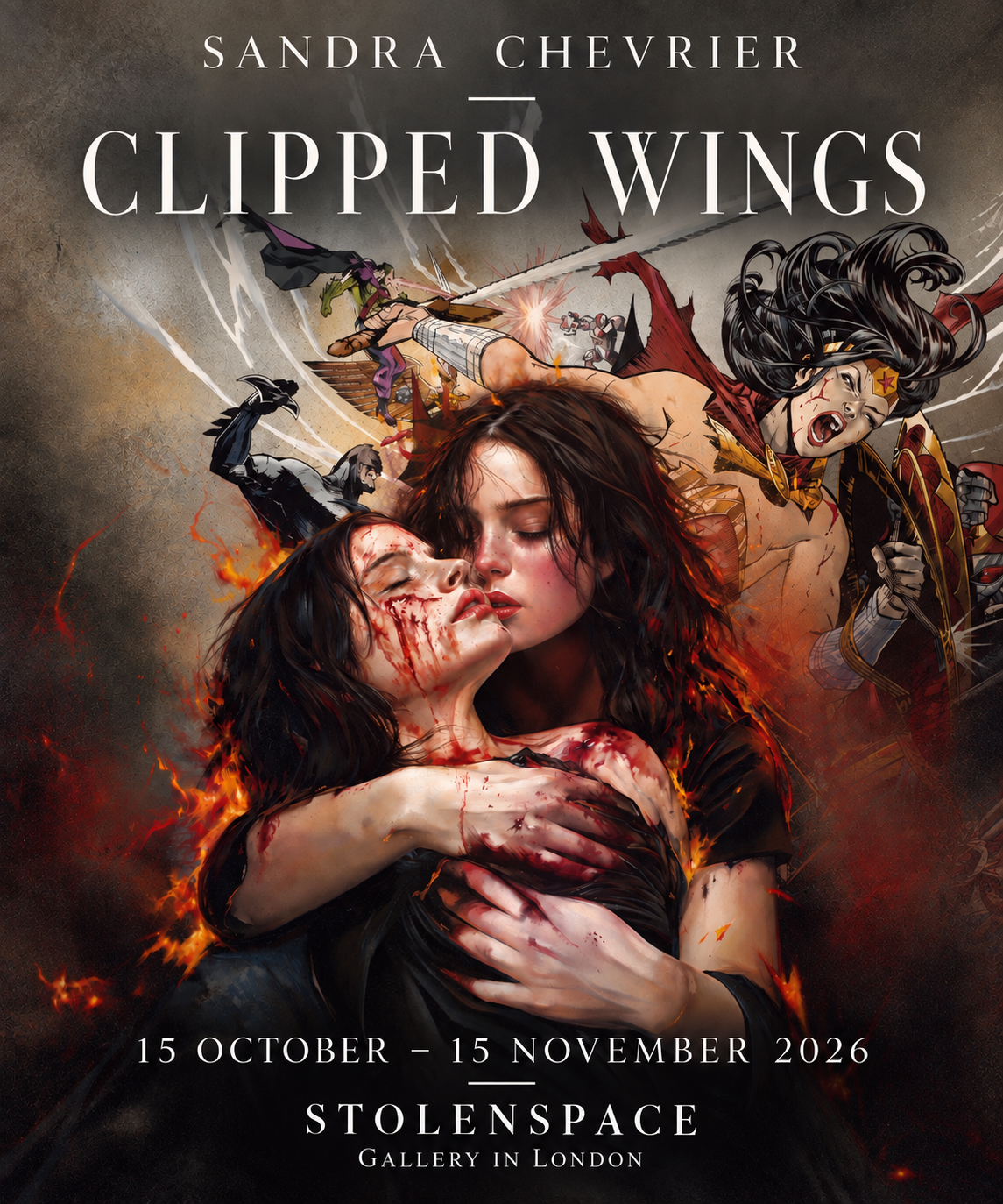
La Cage, entracte avec orchestre (The Cage, orchestral intermission) 44X56'' acrylic on canvas, 2026
Clipped Wings
Sandra Chevrier
15 October - 15 November 2026
Clipped Wings explores the tension between freedom and restraint, vulnerability and survival, desire and the forces that keep us grounded
Please click here to register interest
The opening reception will take place Thursday 15th October, 6pm onwards
There is a particular kind of violence in being taught how far you are allowed to fly.
Clipped Wings explores the tension between freedom and restraint, vulnerability and survival, desire and the forces that keep us grounded. Through fragmented bodies, intimate embraces, wounded faces, and birds caught between flight and captivity, the works inhabit a space where tenderness and violence coexist.
The bird has long been a symbol of freedom. Yet a bird does not need to be behind bars to be imprisoned. Sometimes the cage is invisible. Sometimes the wings are still there, but something has taught us not to use them.
In these paintings, figures seem caught in moments of suspension; holding one another, protecting one another, consuming one another. Love can become refuge, but it can also become a place where we disappear. The body can be both a sanctuary and a battlefield. What appears to be an act of protection may conceal fear; what looks like surrender may contain resistance.
At the same time, these works turn toward the strength that can emerge between women. Vulnerability is not presented as weakness, but as a space from which solidarity, empathy, and resistance can grow. One woman reaches toward another in a moment of defeat, offering support where there was once isolation. In another, a woman stands at the threshold of becoming the successor to a fallen superhero, a reversal of the traditional mythology in which strength, protection, and heroism have so often been embodied by men. She does not wait to be rescued. She rises to carry the story forward.
These moments speak to a form of female empowerment that is not about becoming invulnerable. It is about recognizing our own strength, and sometimes finding that strength through one another. Vulnerability becomes a space for connection rather than isolation, where one woman can hold another through moments of uncertainty, grief, or defeat. The act of reaching toward another woman becomes an act of resistance, a reminder that strength does not always mean standing alone.
As in my previous work, I juxtapose deeply human figures with fragments drawn from the world of comic books. These fictional characters become almost ghostlike presence, they are projections of emotions, memories, and fantasies that inhabit our relationships. They evoke the stories and mythologies that surrounded us as we grew up, shaping our ideas of love, femininity, masculinity, power, and heroism.
By removing these characters from their original narratives and weaving them into intimate and often fragile human moments, I question the roles they were originally given. The familiar becomes displaced, fragmented, and reimagined. The hero can fall. The woman can become the protector. The supporting character can become the protagonist. The mythology can be rewritten.
The ornate frame itself becomes another kind of cage. Historically associated with portraiture, beauty, status, and the preservation of an idealized image, it can both celebrate and confine. By placing fragmented contemporary figures within these traditional structures, I explore the tension between being seen and being defined, between being admired and being possessed by the gaze of others. The women are framed, but they are also confronting the viewer.
The fragmentation of the female body also speaks to the ways women have historically been reduced to individual parts: to the eyes, the lips, the face, the body, as objects of desire, admiration, or judgment. By isolating these fragments, I seek not to further objectify the female figure, but to reclaim these parts as sites of identity and agency. An eye becomes a gaze. A mouth becomes a voice. A fragment becomes something that cannot be entirely possessed or defined by the viewer.
In this sense, the works question not only the cages we inhabit, but also the images that have taught us what we are supposed to be. The stories we inherit can become invisible structures: ideas about femininity, beauty, love, strength, and heroism that shape us long before we are conscious of them. To break free may therefore mean more than escaping a physical or emotional confinement. It may mean reclaiming the right to define ourselves.
Ultimately, these works are less about idealized love than about what lies beneath it: the need to be seen, touched, chosen, and protected, alongside the awareness that every form of attachment carries the possibility of pain. They ask what happens when the structures that have confined us, whether emotional, cultural, societal, or internal, begin to fracture.
The birds in Clipped Wings exist somewhere between captivity and escape. Some are enclosed. Others are already in motion, their wings ignited as if freedom itself carries the possibility of destruction. They suggest that liberation is not always a clean or triumphant act. Sometimes leaving the cage means confronting everything that kept us inside it. Sometimes freedom means discovering that the wings we thought were broken are still capable of carrying us.
Between tenderness and violence, reality and fiction, vulnerability and strength, these works inhabit that fragile place where love can become both our greatest refuge and our greatest vulnerability.
Ultimately, Clipped Wings is not about the absence of freedom, but about the struggle to reclaim it.
It asks what remains of us when our wings have been damaged and whether they can still carry us somewhere new.
With all my Gratitude,
Hope to see you there
Sandra
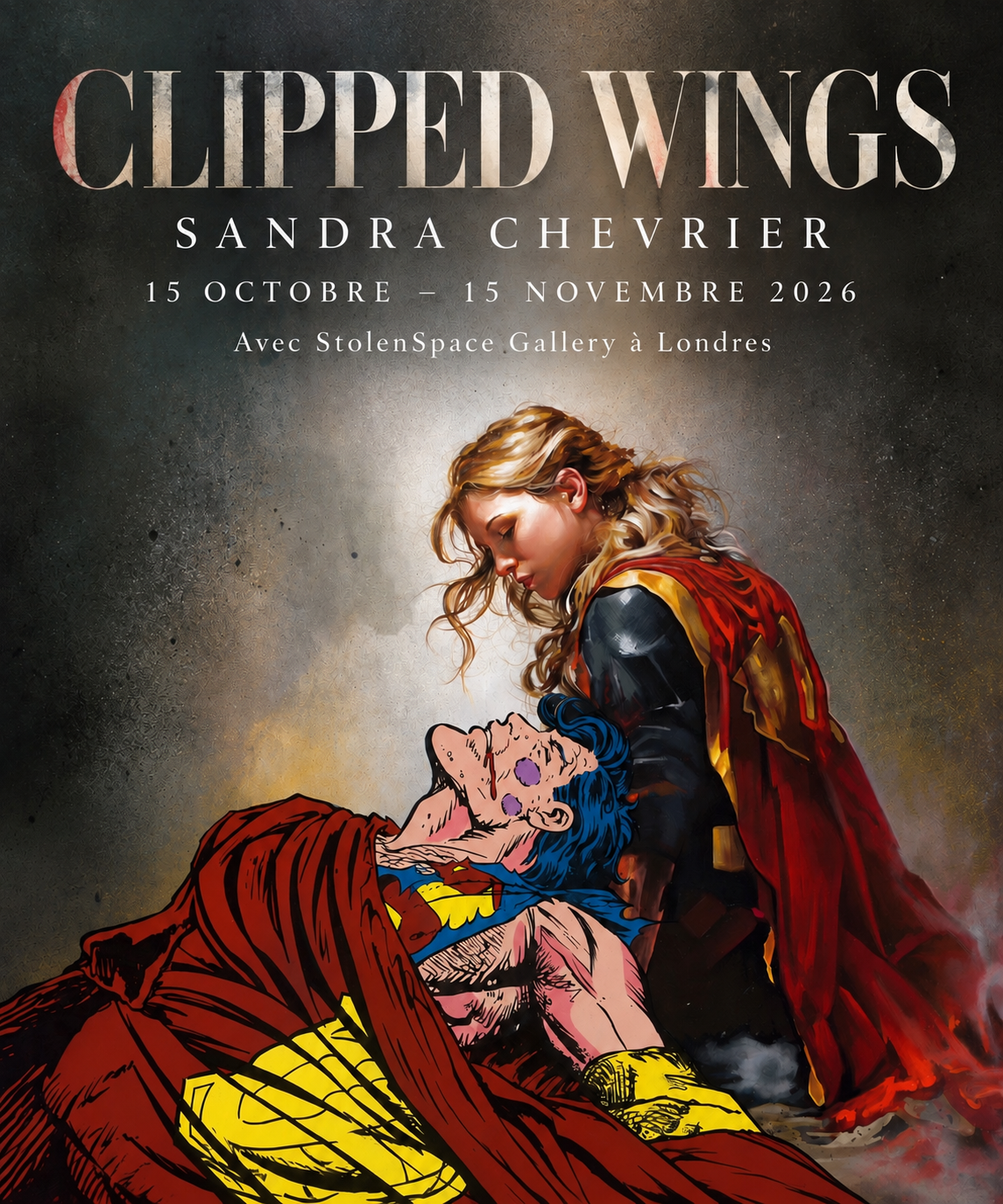
La Cage, ton sang est mon sang (Your blood is my blood) 16X20''Framed 24X28'', acrylic on canvas, 2026
CLIPPED WINGS
SANDRA CHEVRIER
15 octobre – 15 novembre 2026
Avec StolenSpace Gallery à Londres
Cher collectionneur, chère collectionneuse,
J’ai le plaisir de vous annoncer ma prochaine exposition solo, Clipped Wings, présentée avec StolenSpace Gallery à Londres.
Il existe une forme particulière de violence dans le fait d’apprendre jusqu’où l’on a le droit de voler.
Clipped Wings explore la tension entre la liberté et la contrainte, la vulnérabilité et la survie, le désir et les forces qui nous maintiennent au sol. À travers des corps fragmentés, des étreintes intimes, des visages blessés et des oiseaux pris entre l’envol et la captivité, les œuvres habitent un espace où la tendresse et la violence coexistent.
La réception d’ouverture aura lieu le jeudi 15 octobre, à partir de 18 h.
[Cliquez ici pour manifester votre intérêt.]
CLIPPED WINGS
L’oiseau est depuis longtemps un symbole de liberté. Pourtant, il n’a pas besoin d’être derrière des barreaux pour être prisonnier. Parfois, la cage est invisible. Parfois, les ailes sont toujours là, mais quelque chose nous a appris à ne plus nous en servir.
Dans ces peintures, les figures semblent suspendues dans des instants incertains : elles se tiennent, se protègent, se consument les unes les autres. L’amour peut devenir un refuge, mais il peut aussi devenir un endroit où l’on disparaît. Le corps peut être à la fois un sanctuaire et un champ de bataille. Ce qui semble être un geste de protection peut dissimuler la peur ; ce qui ressemble à un abandon peut contenir une forme de résistance.
En parallèle, ces œuvres se tournent vers la force qui peut naître entre les femmes. La vulnérabilité n’y est pas présentée comme une faiblesse, mais comme un espace d’où peuvent émerger la solidarité, l’empathie et la résistance. Une femme tend la main vers une autre dans un moment de défaite, lui offrant un soutien là où il n’y avait autrefois que l’isolement. Dans une autre œuvre, une femme se tient au seuil de devenir l’héritière d’un superhéros tombé au combat, une inversion de la mythologie traditionnelle dans laquelle la force, la protection et l’héroïsme ont si souvent été incarnés par des hommes. Elle n’attend pas d’être sauvée. Elle se relève pour poursuivre l’histoire.
Ces instants évoquent une forme d’émancipation féminine qui ne consiste pas à devenir invulnérable. Il s’agit de reconnaître sa propre force et, parfois, de découvrir cette force à travers l’autre. La vulnérabilité devient un espace de connexion plutôt que d’isolement, où une femme peut soutenir une autre dans les moments d’incertitude, de deuil ou de défaite. Le geste de tendre la main vers une autre femme devient alors un acte de résistance, un rappel que la force ne signifie pas toujours devoir affronter le monde seule.
Comme dans mes travaux précédents, je juxtapose des figures profondément humaines à des fragments issus de l’univers de la bande dessinée. Ces personnages fictifs deviennent des présences presque fantomatiques : des projections d’émotions, de souvenirs et de fantasmes qui habitent nos relations. Ils évoquent les récits et les mythologies qui nous entouraient durant notre enfance, façonnant nos conceptions de l’amour, de la féminité, de la masculinité, du pouvoir et de l’héroïsme.
En retirant ces personnages de leurs récits d’origine pour les intégrer à des moments humains intimes et souvent fragiles, je remets en question les rôles qui leur avaient été attribués. Le familier est déplacé, fragmenté et réinventé. Le héros peut tomber. La femme peut devenir la protectrice. Le personnage secondaire peut devenir le protagoniste. La mythologie peut être réécrite.
Le cadre ornementé devient lui aussi une autre forme de cage. Historiquement associé au portrait, à la beauté, au statut social et à la préservation d’une image idéalisée, il peut à la fois célébrer et enfermer. En plaçant des figures contemporaines fragmentées dans ces structures traditionnelles, j’explore la tension entre le fait d’être regardée et celui d’être définie, entre être admirée et être possédée par le regard des autres. Les femmes sont encadrées, mais elles confrontent également le spectateur.
La fragmentation du corps féminin évoque aussi la manière dont les femmes ont historiquement été réduites à certaines parties de leur corps : les yeux, les lèvres, le visage, le corps,autant d’éléments considérés comme des objets de désir, d’admiration ou de jugement. En isolant ces fragments, je ne cherche pas à objectifier davantage la figure féminine, mais à reprendre possession de ces parties comme lieux d’identité et de pouvoir d’agir. Un œil devient un regard. Une bouche devient une voix. Un fragment devient quelque chose qui ne peut être entièrement possédé ou défini par celui qui le regarde.
En ce sens, les œuvres interrogent non seulement les cages que nous habitons, mais aussi les images qui nous ont appris ce que nous étions censées être. Les récits dont nous héritons peuvent devenir des structures invisibles : des idées sur la féminité, la beauté, l’amour, la force et l’héroïsme qui nous façonnent bien avant que nous en ayons conscience. Se libérer peut donc signifier bien davantage que s’échapper d’un enfermement physique ou émotionnel. Cela peut signifier reprendre le droit de nous définir nous-mêmes.
En définitive, ces œuvres parlent moins de l’amour idéalisé que de ce qui se trouve sous sa surface : le besoin d’être vue, touchée, choisie et protégée, accompagné de la conscience que toute forme d’attachement porte en elle la possibilité de la douleur. Elles interrogent ce qui se produit lorsque les structures qui nous ont enfermées, qu’elles soient émotionnelles, culturelles, sociales ou intérieures, commencent à se fissurer.
Les oiseaux de Clipped Wings existent quelque part entre la captivité et l’évasion. Certains sont enfermés. D’autres sont déjà en mouvement, leurs ailes embrasées comme si la liberté elle-même portait la possibilité de la destruction. Ils suggèrent que la libération n’est pas toujours un geste propre, simple ou triomphant. Parfois, quitter la cage signifie affronter tout ce qui nous y retenait. Parfois, la liberté consiste à découvrir que les ailes que nous croyions brisées sont encore capables de nous porter vers quelque chose de nouveau.
Entre tendresse et violence, réalité et fiction, vulnérabilité et force, ces œuvres habitent cet espace fragile où l’amour peut devenir à la fois notre plus grand refuge et notre plus grande vulnérabilité.
En définitive, Clipped Wings ne parle pas de l’absence de liberté, mais de la lutte pour la reconquérir.
L’exposition pose la question de ce qu’il reste de nous lorsque nos ailes ont été abîmées et de leur capacité à nous porter encore vers un nouvel horizon.
J’ai hâte de vous présenter ce nouveau corpus d’œuvres à Londres.
Avec toute ma gratitude,
Sandra Chevrier